How to Gain Weight in a Healthy Way
How to Gain Weight in a Healthy Way
Not everyone is trying to lose weight. If you have been told you are underweight, you are recovering from illness, you are an athlete trying to build strength, or you simply want to add muscle mass, gaining weight in a healthy and deliberate way is just as valid a goal as losing it. The challenge is making sure the weight you add is mostly lean tissue and not excess body fat.
This guide walks you through exactly how to do that.
---
Why Healthy Weight Gain Is Different from Just "Eating More"
Anyone can gain weight by eating a large amount of fast food every day. The problem is that approach tends to pack on visceral fat, raise blood lipids, and leave you feeling sluggish. Healthy weight gain means being intentional about what you eat, not just how much.
The goal is a modest calorie surplus paired with enough protein and resistance training to direct those extra calories toward muscle rather than fat storage.
Key principle: Slow and steady gains — roughly 0.25 to 0.5 kg (0.5–1 lb) per week for most people — minimise unwanted fat gain while giving your body time to build real tissue.
---
Step 1 — Work Out Your Calorie Surplus
To gain weight you need to eat more calories than you burn. A daily surplus of roughly 250–500 calories above your total daily energy expenditure (TDEE) is a reasonable starting point for most people. A smaller surplus leads to slower, leaner gains; a larger surplus speeds things up but increases fat gain.
If you are unsure what your TDEE is, check out our guide on understanding your TDEE — it explains exactly how to calculate the number of calories your body needs each day before you add any surplus.
---
Step 2 — Prioritise Protein
Protein is the building block of muscle. Without enough of it, the extra calories you eat have nowhere productive to go.
A general guideline widely used by sports dietitians:
| Goal | Suggested Protein Intake |
|---|---|
| General healthy gain | 1.2–1.6 g per kg of body weight per day |
| Active muscle building | 1.6–2.2 g per kg of body weight per day |
| Recovery from illness | Discuss with a healthcare professional |
Good protein sources include chicken, turkey, fish, eggs, Greek yogurt, cottage cheese, legumes, tofu, and tempeh. Spread your intake across meals rather than trying to eat it all at once.
---
Step 3 — Choose Calorie-Dense, Nutrient-Rich Foods
Eating a large volume of food can feel uncomfortable, especially if you have a smaller appetite. The trick is to choose foods that pack a lot of calories and nutrients into a compact serving.
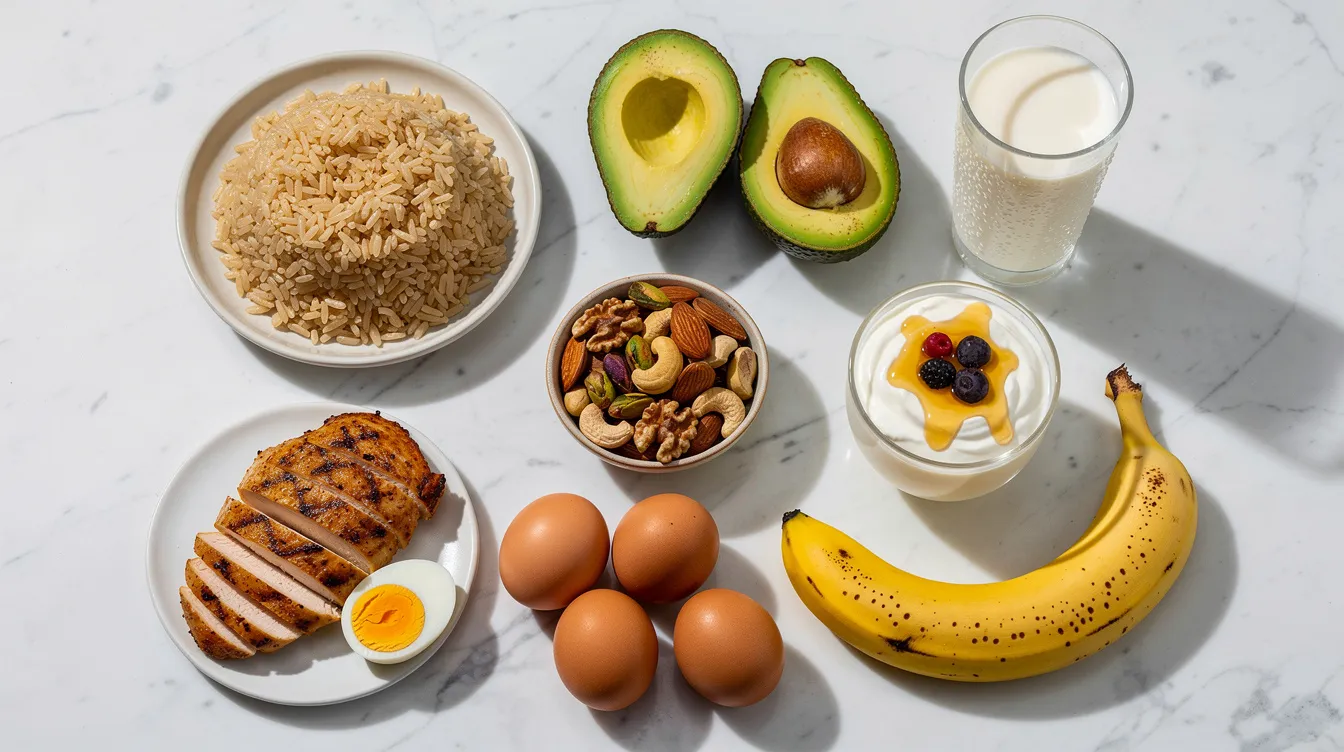
Best calorie-dense whole foods for healthy weight gain:
- Nuts and nut butters — a small handful of almonds or a couple of tablespoons of peanut butter adds 150–200 calories effortlessly
- Avocados — full of healthy monounsaturated fats, about 200–300 calories each
- Whole eggs — roughly 70–80 calories per egg plus high-quality protein
- Olive oil and oily fish — salmon, mackerel and sardines provide omega-3s alongside calories
- Whole grains — oats, brown rice and quinoa deliver carbohydrates, fibre and micronutrients
- Starchy vegetables — sweet potatoes, butternut squash and corn are more calorie-dense than leafy greens
- Full-fat dairy — whole milk, full-fat yogurt and cheese are practical calorie boosters
- Dried fruit — dates, raisins and apricots are convenient and energy-dense
---
Step 4 — Eat More Frequently
If you struggle to eat enough in three meals, try adding one or two nutrient-dense snacks between meals. A mid-morning snack of a banana with almond butter and a glass of whole milk can add 400–500 calories without replacing any meal.
Sample snack ideas:
- Greek yogurt with granola and honey
- Whole-grain toast with avocado and a boiled egg
- Smoothie made with whole milk, banana, oats and peanut butter
- A small bowl of mixed nuts and dried mango
- Rice cakes with cottage cheese and sliced tomato
---
Step 5 — Lift Weights
Nutrition alone will not ensure the weight you gain is lean mass. Resistance training signals your muscles to grow and use those extra protein and calories productively. You do not need to become a competitive bodybuilder — two to four sessions a week covering the major muscle groups (squats, deadlifts, rows, presses) is plenty for most people.
If you are new to lifting, consider working with a qualified personal trainer for a few sessions to learn safe technique.
---
Step 6 — Track What You Actually Eat
Most people who struggle to gain weight are surprised when they log their food and realise they are eating far less than they thought. Consistent tracking removes the guesswork.
Cal AI: Calorie Scanner makes this easy — snap a photo of your plate and instantly see the calories, protein, carbs and fat in what you are eating, along with a personalised daily goal based on your body stats and weight-gain target.
---
Common Mistakes to Avoid
- Going too fast — a surplus of 1,000+ calories a day will add fat quickly and can be hard to sustain
- Skimping on protein — extra calories without adequate protein mostly become fat
- Skipping training — without a training stimulus, muscle growth stalls regardless of nutrition
- Relying on junk food — ultra-processed foods are easy calories but lack the micronutrients your body needs to perform and recover
- Comparing yourself to others — genetics influence how quickly and where you gain; focus on your own trend over weeks
---
How to Know It Is Working
Weigh yourself at the same time each day (ideally in the morning after using the bathroom) and look at your weekly average, not the daily number. A consistent upward trend of 0.25–0.5 kg per week over a month is a strong signal your approach is working. If the scale is not moving after two to three weeks, add another 100–200 calories per day and reassess.
---
The Bottom Line
Healthy weight gain comes down to three pillars: a modest calorie surplus, plenty of protein, and progressive resistance training. Choose whole, nutrient-dense foods the majority of the time, eat consistently, and be patient. Lean mass takes time to build — but the results are durable and genuinely good for your health. Start small, track honestly, and adjust as you go.